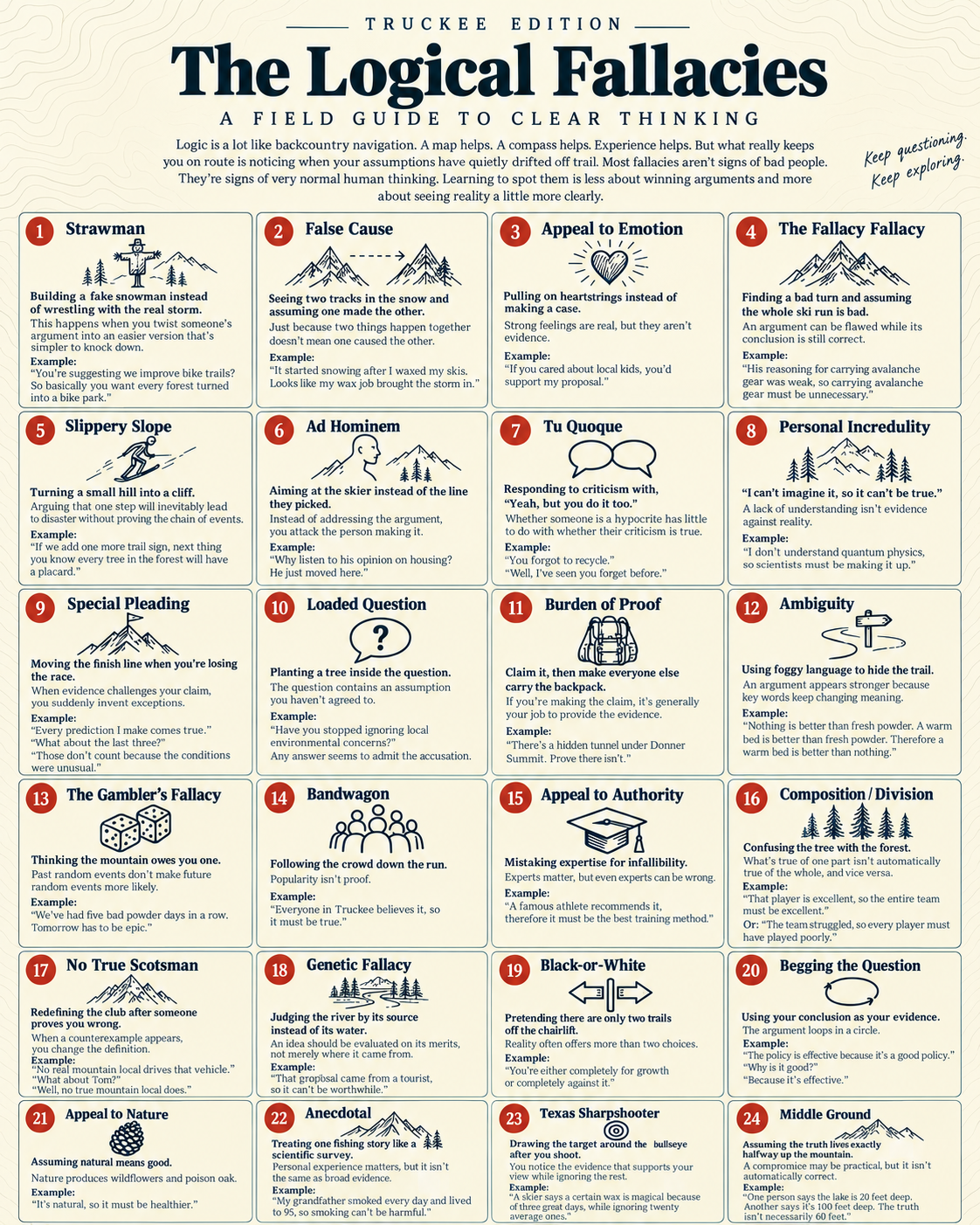
- 1
Strawman
Building a fake snowman instead of wrestling with the real storm.
This happens when you twist someone’s argument into an easier version that’s simpler to knock down.
- 2
False Cause
Seeing two tracks in the snow and assuming one made the other.
Just because two things happen together doesn’t mean one caused the other.
- 3
Appeal to Emotion
Pulling on heartstrings instead of making a case.
Strong feelings are real, but they aren’t evidence.
- 4
The Fallacy Fallacy
Finding a bad turn and assuming the whole ski run is bad.
An argument can be flawed while its conclusion is still correct.
- 5
Slippery Slope
Turning a small hill into a cliff.
Arguing that one step will inevitably lead to disaster without proving the chain of events.
- 6
Ad Hominem
Aiming at the skier instead of the line they picked.
Instead of addressing the argument, you attack the person making it.
- 7
Tu Quoque
Responding to criticism with, “Yeah, but you do it too.”
Whether someone is a hypocrite has little to do with whether their criticism is true.
- 8
Personal Incredulity
“I can’t imagine it, so it can’t be true.”
A lack of understanding isn’t evidence against reality.
- 9
Special Pleading
Moving the finish line when you’re losing the race.
When evidence challenges your claim, you suddenly invent exceptions.
- 10
Loaded Question
Planting a tree inside the question.
The question contains an assumption you haven’t agreed to.
- 11
Burden of Proof
Claim it, then make everyone else carry the backpack.
If you’re making the claim, it’s generally your job to provide the evidence.
- 12
Ambiguity
Using foggy language to hide the trail.
An argument appears stronger because key words keep changing meaning.
- 13
The Gambler’s Fallacy
Thinking the mountain owes you one.
Past random events don’t make future random events more likely.
- 14
Bandwagon
Following the crowd down the run.
Popularity isn’t proof.
- 15
Appeal to Authority
Mistaking expertise for infallibility.
Experts matter, but even experts can be wrong.
- 16
Composition / Division
Confusing the tree with the forest.
What’s true of one part isn’t automatically true of the whole, and vice versa.
- 17
No True Scotsman
Redefining the club after someone proves you wrong.
When a counterexample appears, you change the definition.
- 18
Genetic Fallacy
Judging the river by its source instead of its water.
An idea should be evaluated on its merits, not merely where it came from.
- 19
Black-or-White
Pretending there are only two trails off the chairlift.
Reality often offers more than two choices.
- 20
Begging the Question
Using your conclusion as your evidence.
The argument loops in a circle.
- 21
Appeal to Nature
Assuming natural means good.
Nature produces wildflowers and poison oak.
- 22
Anecdotal
Treating one fishing story like a scientific survey.
Personal experience matters, but it isn’t the same as broad evidence.
- 23
Texas Sharpshooter
Drawing the target around the bullseye after you shoot.
You notice the evidence that supports your view while ignoring the rest.
- 24
Middle Ground
Assuming the truth lives exactly halfway up the mountain.
A compromise may be practical, but it isn’t automatically correct.
The original
The poster